TWO:In such very discouraging circumstances the American campaign began. Whilst insurrection was in their camp, Sir Henry Clinton dispatched General Arnold to make a descent upon the coast of Virginia. That general had been dispatched into that quarter, at the close of the year, with one thousand six hundred men, in ships so bad, that they were obliged to fling overboard some of their horses. Arnold, however, first sailed up the river James, and landed at Westover, only twenty-five miles from Richmond, the capital of Virginia. Jefferson, who was Governor of Virginia, was seized with great alarm; for, though the militia of the State were nominally fifty thousand, he could muster only a few hundreds. He therefore hastily collected what property he could, and fled up the country, dreading to fall into the hands of a man so embittered against the Americans as Arnold was, who was himself well aware that they had determined to hang him without mercy if they caught him. Arnold did not allow much time to elapse without action. The next day he was in Richmond, and sent word to Jefferson that, provided British vessels might come up the river to take away the tobacco, he would spare the town. Jefferson rejected the proposal, and Arnold burnt all the tobacco stores and the public buildings, both there and at Westham. After committing other ravages, he returned to Portsmouth, on Elizabeth River, where he entrenched himself. On the 26th of March, General Phillips, having assumed the command, in company with Arnold ascended James River with two thousand five hundred men, took and destroyed much property in Williamsburg and York Town, ravaged the country around, and then sailed to the mouth of the Appomattox, and burnt all the shipping and tobacco in Petersburg. After other depredations, and forcing the Americans to destroy their own flotilla between Warwick and Richmond, Phillips and Arnold descended the James River to Manchester, and proposed to cross over to Richmond. But Lafayette having just reached that place before them with upwards of two thousand men, they re-embarked, and, after destroying much other property, especially shipping and stores, at Warwick and other places, they fell down to Hog Island, where they awaited further orders.
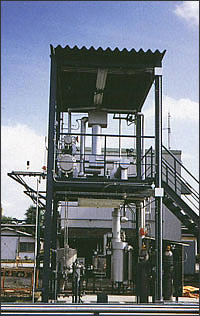
Great attention is recently being paid to global environmental issues, and it is now conceivable that companies will need to treat used solvents themselves. In consideration of this kind of social issue, we have developed a “membrane separation type solvent dehydration system,” which uses a polyimide membrane with superior dehydration properties developed by Ube Industries, Ltd. in combination with our own distillation and concentration technology that has resulted in solvents being more easily recovered.
THREE:(After the Portrait by J. B. Greuze.)
- 1Under the distillation system, even in case of azeotropic solvent compositions, this system which remove water vapor by the polyimide membrane will easily dehydrate.
- 2In comparison with the distillation system, it significantly saves on use of steam.
- 3Dehydration can be performed through merely supplying evaporated vapor to the membrane module and maintaining the differential pressure between the permeable side and the impermeable side.
- 4Solvent purity of 99.9% or more can be achieved by carrying out dehydration with a polyimide membrane only.
- 5The polyimide membrane has superior heat and solvent resistance. Therefore, the vapor permeation system reduces contamination of the membrane and thus extends its life.
THREE:The Duke of Wellington was informed, at Brussels, on the same day, of this attack of Napoleon on the Prussians at Ligny, and of the British advance, under the Prince of Orange, at Quatre Bras. It has been said that he was taken by surprise. Quite the contrary. He was waiting in the most suitable position for the movement of Buonaparte. This was announced to him by a Prussian officer of high rank, said to be Baron Müffling, who arrived at half-past one at his hotel in Brussels. Wellington immediately dispatched orders to all the cantonments of his army to break up and concentrate on Quatre Bras, his intention being that his whole force should be there by eleven o'clock the next night, Friday, the 16th. At three o'clock his Grace sat down to dinner, and it was at first proposed that notice should be sent to the Duchess of Richmond to put off a ball which she was going to give at her hotel that evening; but, on further consideration, it was concluded to let the ball proceed, and that the Duke and his officers should attend it, as though nothing was about to occur, by which the great inconvenience of having the whole city in confusion during their preparations for departure would be avoided. Accordingly, every officer received orders to quit the ball-room, and as quietly as possible, at ten o'clock, and proceed to his respective division en route. This arrangement was carried out, and the Duke himself remained at the ball till twelve o'clock, and left Brussels the next morning (April 16) at six[95] o'clock for Quatre Bras. Such were the facts which gave rise to the widespread report that the Duke knew nothing of the attack of Napoleon till the thunder of his cannon was heard by the Duke of Brunswick in the ball-room.
The aromatic polyimide membrane is highly permeable to water vapor but less permeable to vapors of organic compounds such as alcohol etc.
THREE:O'CONNELL RETURNING HOME FROM PRISON. (See p. 532.)Amongst the foremost of the promoters of science, and the most eloquent of its expounders, was Sir David Brewster, who died full of years and of honours in 1868. Arrived at manhood at the opening of the present century, having been born in 1781, he continued his brilliant course during fifty years, pursuing his investigations into the laws of polarisation by crystals, and by the reflection, refraction, and absorption of light, in which he made important discoveries. The attention of the British public was forcibly arrested by an able treatise on "Light," contributed by Sir John Herschel, in 1827, to the "Encyclop?dia Metropolitana." Its excellent method and lucid explanations attracted to the theory of Young and Fresnel men of science who had been deterred by the fragmentary and abstruse style of the former. This was followed four years later by a most able and precise mathematical exposition of the theory, and its application to optical problems, by Professor Airy, who became Astronomer-Royal in 1835.
- 1 Recovery of the detergent solvent Recovery of the cleaning solvent such as electronic parts industry, precision instrument industry.
- 2Solvent recovery and the refinement Solvent recovery and the refinement such as chemical industry, an industry of medical supplies, food industry, the fermentation industry.
THREE:[See larger version]
Acetone, ethanol, methyl ethyl ketone, butanol, isopropyl alcohol, ethyl acetate, methyl isobutyl ketone, others (including hexane and toluene).
